The State of Play: Finding the Humanity in Artificial Intelligence
- Backlog

Key Takeaways
- Love it or hate it, AI has arrived—* and has rapidly revolutionized the way we live, work, and play.
- Whether you choose to use or not use it, understanding the possibilities AI presents is vital to navigating these cultural shifts.
- Putting benefits like affordability and speed aside, AI fails on one front: fully replicating human emotion and creativity.
- Firefli believes that productivity and humanity can (and should) coexist. Keep reading to see how that belief informs our adoption of AI.
The concept of an ultra-powerful, seemingly-omniscient technology that rivals human intelligence is no longer reserved for dystopian novels and science fiction movies. AI is here. And it has quickly become, for better or worse, an unavoidable reality of our modern world.
“I’ve been doing this a long time,” remarks Greg Brock, Firefli’s founder + CEO. “I lived through the dot-com boom and bust. I watched technology completely upend industries that couldn’t imagine how much their worlds were about to change. AI reminds me of those moments, when you could sense something much bigger was underway, even if no one could fully see where it was going yet. The difference is, I believe what we’re experiencing with AI will ultimately be even more consequential.”
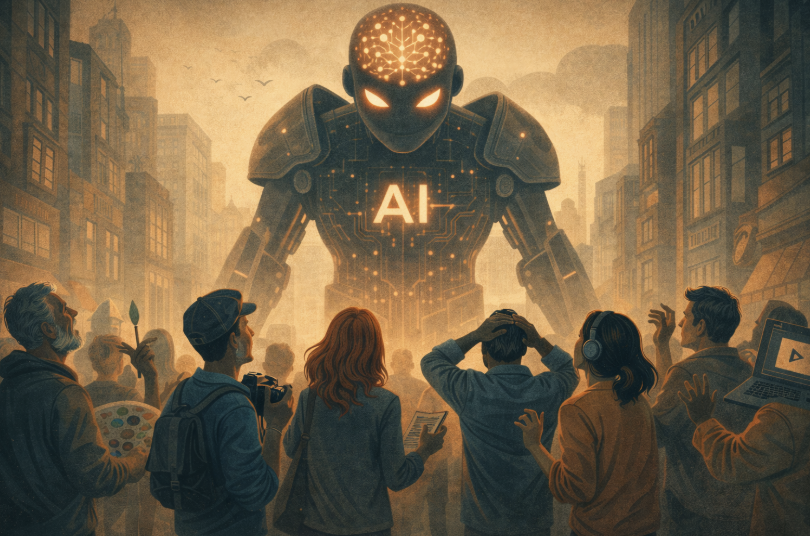
Welcome to the AI era.
Whether by choice or happenstance, many of us encounter some form of artificial intelligence every day. It seems to be baked into everything now: apps, internet browsers, websites, software platforms. The refrigerator sitting in your kitchen.
And it’s not just online. It’s on our televisions, being used to make commercials. It’s in our schools, being used by the minds of tomorrow to outsource homework assignments and essay writing. It’s in our communities, inspiring passionate discussions around environmental impact and job loss. AI is everywhere. But that level of oversaturation has actually started to counteract its momentum.
Overexposure has soured the public’s perception of AI for some time now,” explains Donald Manness, our Front End Developer. “Recently, the CEOs of AI-forward companies, and even the AI companies themselves, have been forced to moderate their stances.”
Meta is just one example, recently abandoning a plan to replace a huge percentage of their workforce with AI after major backlash from staff.
Why you should care
You don’t have to be a multibillion dollar tech conglomerate to recognize that AI is fundamentally reshaping our entire digital ecosystem. The ways in which people discover, research, and evaluate your company have completely changed. The boundaries that once separated your website, your SEO, your social media, your analytics, and your advertising are collapsing at a rapid pace. And the connection between your reputation, your expertise, and your digital presence is becoming more and more inextricable.
Successfully navigating these shifts requires, at minimum, some understanding of artificial intelligence, what it can do, and the expectations people have surrounding it. Simply put, the more you know about the potential AI possesses, the more you’ll be able to use it to your benefit.
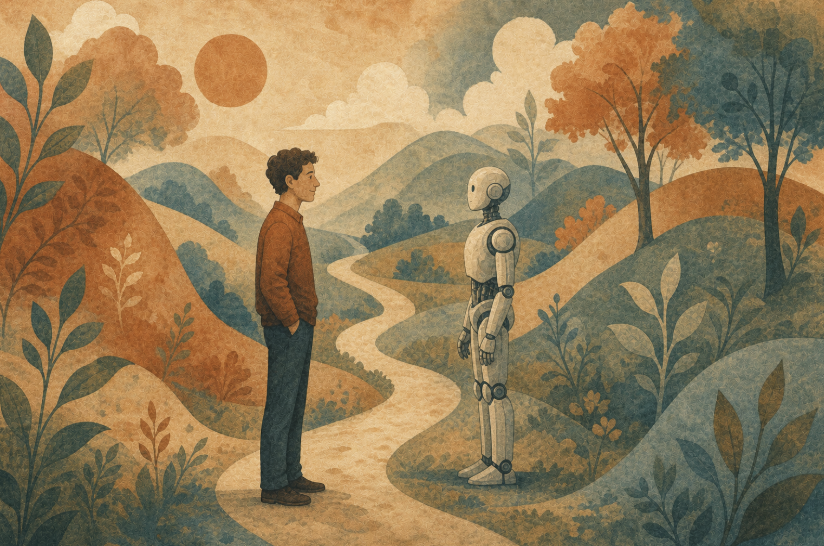
Appealing to feeling
Aside from the many possibilities posed by AI, one of its most extreme impacts has been on the spirit of art itself. These technologies are designed, in part, as “bottled” creativity that’s fast, affordable, and accessible. It’s easier than ever for anyone, regardless of experience or natural talent, to generate an ad. A photo. An insightful paragraph.
But creativity that comes at ten times the speed and a fraction of the cost still has a high price. And we’re not just talking about the 20.7% of creative roles that are projected to be eliminated or fundamentally restructured due to AI by 2030. We’re talking about the loss of emotional connection to the art we encounter.
Every form of creative output—commercials, social media posts, articles, books, movies, television shows, songs, photographs, you name it—rely on one thing to be successful: our ability, as humans, to feel something. This incontrovertible fact begs the question: can AI ever capture the creativity and emotion that only comes from lived human experience? And if it can’t, is that something we should willingly sacrifice in the name of “faster and cheaper”?
Matt Trussell, our Designer, says no. “As a creative, I value original ideas and human processes. I think the entire world could slow down a little and spend a bit more time focusing on using what gifts we possess as human beings.”
Of course,” he adds. “We can’t get around using AI altogether. We’ve all been using it in small ways for years…but I think it’s more about being very intentional with how we use it.”
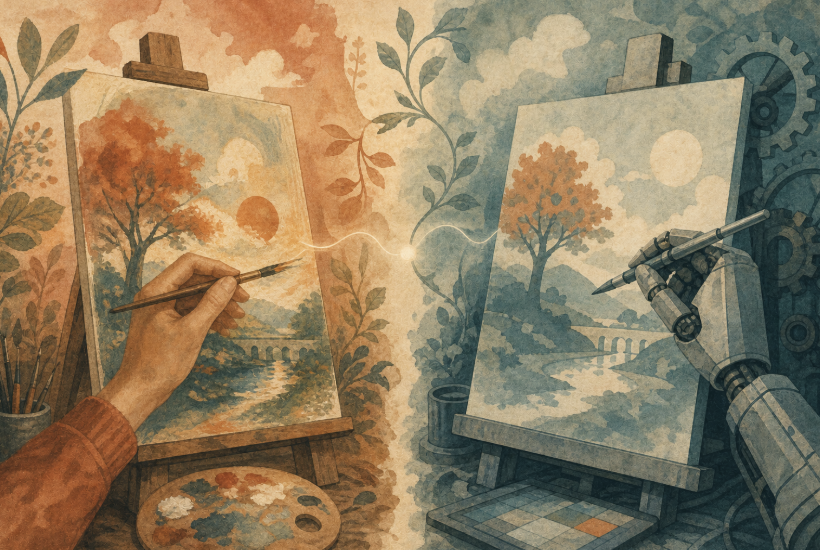
AI prioritizes speed over human insight.
We believe you need both.
The world spins on. People choose to love, hate, or not care about AI. And agencies like Firefli are left to decide for themselves where they fall on the spectrum.
Firefli has a policy that AI-generated output isn’t allowed to become client work,” says Greg Brock. “There has to be a human responsible for what leaves Firefli— someone who understands the client, the audiences, and the context of things. Someone who can make a judgment about whether something is actually good rather than just complete.“
By using it with responsibility and intention, Firefli has found a way to make AI be what it was always meant to be: a tool.
“I think Firefli has had the only correct approach to AI…” asserts Donald Manness. “…which is to trust the team with this technology and let them figure out where and how it fits into their workflow—and, just as importantly, where it doesn’t.”
Where it fits in at Firefli
Mindless tasks
John Cornthwait, Firefli’s President + COO, doesn’t like to start with AI. He’d rather use it for repetitive tasks that are important but also take up a lot of time. “Things like pulling specific reports and collating them in a single place for review,” he explains. “Or pushing data into a log and reviewing the log over a period of time. It helps me close the gap between what I should delegate to our team and what I can take off their plates so they can focus on what really matters.”
New perspectives
For Ashley Perez, our Interactive Art Director, AI helps her look at her own work with fresh eyes. “In the world of web design, it helps to know UX, content, strategy, and enough of the technical side to hand work off to developers. AI lets me examine my work through each of those lenses without having to be an expert in every one.”
Clarity building
Beck Stottlar, our Full Stack Developer, treats AI as a collaborator on some of the more high-level aspects of her job. “There are niche areas of work where I need some expertise, and it’s much easier to have a conversation with AI about my specific questions than to spend hours researching and hoping I find someone who has run into a similar problem,” she says.
Beck has also been leading the charge on Answer Engine Optimization (AEO) at Firefli, researching ways to optimize web content for AI-generated answers as opposed to traditional search results. “Every site we build is built with a11y (accessibility) in mind…” she explains. “…and that’s greatly beneficial from an AI perspective. If a screen reader can read website content, AI can, too. So now, if a client asks us to increase their AI presence, we can confidently offer to build off the successful structure we already made for them.”
Staying human in an increasingly digital world
The skyrocketing prevalence of AI has made many things easier to come by: snappy taglines, quick-build websites, and compelling social media posts, to name a few. But one thing AI has made even rarer? Human perspective.
Ironically, I think the value of human judgment is going up, not down,” predicts Greg Brock. “And that’s good for us. Because if we’re doing this correctly—and I think we are—then AI won’t make Firefli less human. It’ll give our people more room to be human.”
*All em dashes in this article were put there by a human.